
Renewing Industrious Christian Womanhood
There is a contemporary, often narrow, view of what a young Christian woman’s life should look like. She is often seen as someone who focuses on homemaking and waits passively for a future spouse. While waiting for this elusive spouse, she might spend her time socializing, visiting popular places, or enjoying the leisure that comes with being single.
In contrast, imagine a young, industrious Christian woman who, instead of letting her days slip by, invests her time in developing her mind and talents. She understands that despite her ability to bake bread, she knows her life is about more than recipes and oven temperatures. She reads well and widely, pursues interests that stretch her mind, learns a new language, and seeks opportunities to gain experience outside of the home. She puts the phone away for hours during the day because she doesn’t fear missing anything. Her focus is fixed on her goals. For her, homemaking is valuable, but it does not define all she is or all she can become.
The prevailing notion that a young Christian woman’s life is defined by intellectual mediocrity stands in stark contrast to a deep historical and biblical tradition. Throughout history, faithful Christian women have challenged this narrow perspective, actively sought wisdom, and refused to settle for limited intellectual growth. This tradition, though ancient, is rarely recognized in some Christian circles that it’s often perceived as revolutionary, even feminist.
The value of a Christian woman’s education transcends practical or economic considerations. Even if she chooses the path of a stay-at-home mother, her education isn’t wasted; its worth doesn’t bow to the world’s profit-driven standards. Instead, education serves a formative purpose: it shapes her character, broadens her vocabulary, and equips her with the language and tools necessary to thoughtfully engage with the world. These benefits are still relevant regardless of her future vocation.
True excellence in a woman is marked by her intentional development of both mind and talents. This pursuit is not merely for the sake of a future spouse but is fundamentally about her own growth as a daughter of the King. She is primarily a beloved daughter and image bearer of God, called to wholeness and holiness. The ultimate fulfillment of a woman’s life is found not solely in marriage or motherhood, but in her pursuit of holiness, reflecting her identity in Christ and purpose in Him beyond the home.
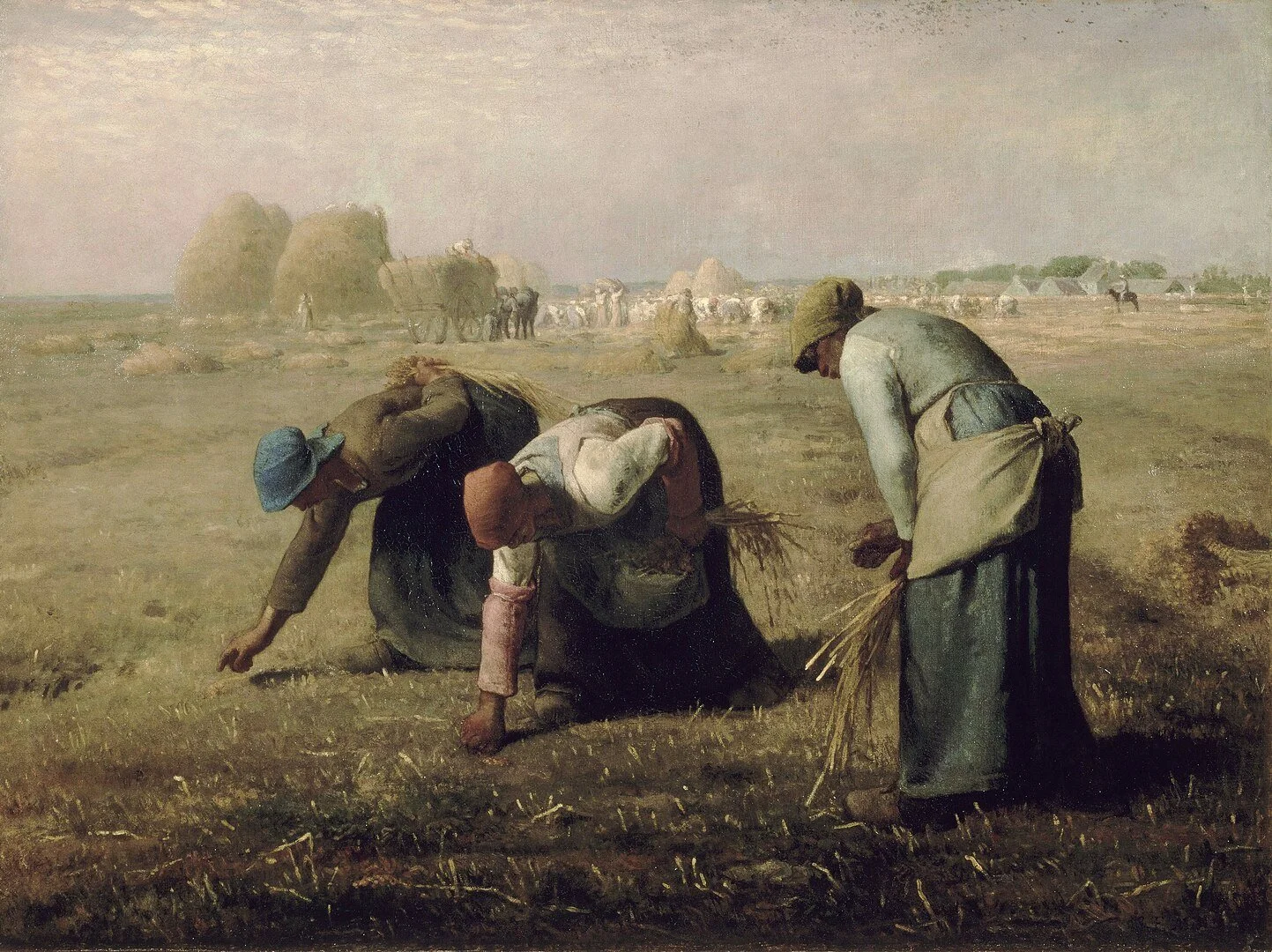
The Gleaners by Jean-Francois Millet (oil on canvas, 1857)
A Legacy of Thought: The Foundational Pursuit of Knowledge
Christine de Pizan, born in France in 1364, stands out in history as the first professional female writer in France. In an era when the belief in women’s intellectual inferiority was widespread, de Pizan confronted a deeply significant question: Is a woman a faulty creation of God?
This earnest and humble question continues to serve as the foundation for the longstanding discussion about female intellectual capacity. Her inquiry stemmed from her personal challenges as a single mother navigating a dangerous world. Widowed at twenty-five, she assumed responsibility for her children without adequate preparation to address her late husband’s debts (at the time, it was customary for husbands not to share financial matters with their wives).
Christine de Pizan’s profound question—whether a woman is a faulty creation of God—arose after she read the writings of Matheolus of Bologna, who claimed that women were a source of suffering for men. This prompted de Pizan to examine the bases of women’s value and dignity. Through careful reflection, she rejected the notion that women were made from vile material. Instead, she affirmed that woman was created from the body of man, formed in the imago Dei—the image of God—and therefore intrinsically worthy of dignity.
Recognizing this truth calls for a reversal of the modern sentiment that accepts mediocrity as a standard for young women. Understanding that women are created in God’s image and endowed with inherent dignity demands that young women pursue excellence and refuse to settle for less than their full potential.
Another question of equal importance over whether women should be formally educated was brought up by Bathsua Makin, born in 1600. She was raised in a household that encouraged a solid education—her father bestowed knowledge of Greek, Latin, French, and Hebrew upon his daughters. By age sixteen, Makin had already collaborated with her father on two publications. Upon presenting her published works to King James, he dismissed her talents with his retort: “But can she spin?”
Later, Makin opened a school for girls in London and wrote An Essay to Revive the Antient Education of Gentlewomen (1673) in defense of women pursuing education. The objections to the education of females were many, and Makin was quick to counter them. She countered the notion that education would distract women from running a home by arguing that anything could be a distraction, even for men; however a man’s education was never denied.
Elisabeth of the Palatinate, born in 1618, was just as curious and inquisitive when she posed her philosophical question: Are mind and body separate?
Elisabeth was also raised with a robust education and knowledge of Greek. She discussed mathematics and philosophy with René Descartes, a French philosopher, through correspondence. She was especially intrigued by Descartes’ cogito ergo sum (I think, therefore I am) argument but questioned how the immaterial mind could affect a material body. She was an example of a curious, intellectual mind that was tenacious at finding answers and modeled rectitude while engaging in profound abstract thought, challenging the beliefs about women staying in their station. Elisabeth is evidence that women of faith have long engaged in profound, abstract thought beyond serving as domestic practitioners.
Anne Dutton, born in 1692, went further by addressing the spiritual dimension of a woman’s intellectual role. She asked: Can women write about theology? Her question challenged the idea that a woman’s intellectual contributions should be limited, particularly within the spiritual realm; however, her question confirmed that the life of an intellectual belonged to her, too.
Eventually, Dutton saw her writing as a ministry to promote the Gospel, publishing over fifty volumes of poetry, letters, treatises, and an autobiography. She defended her intellectual contributions against critics who believed that it was improper for a woman to publish. She argued that her writing was for God’s honor and was not against any biblical mandate (such as keeping silent during public authoritative teaching in the Church). Her writing, she asserted, served to edify and exhort others, regardless of sex. Dutton sought her writing in a peaceful way, and her writing was an instrument of edification for the kingdom. “Let us therefore follow after the things which make for peace, and things wherewith one may edify another.” (Romans 14, verse 19)
The Practical Expression of a Developed Mind
The woman in Proverbs 31 has become a mainstay for single Christian women looking to exemplify their God given role as a future wife and mother.
We know the woman in Proverbs 31 went beyond her domestic responsibilities. She was a partner to her husband, handling his business affairs and she used her might to pursue excellence in all that she put her mind and hands towards. Makin noted that the Proverbs 31 woman required knowledge in natural philosophy to buy wool and flax, to die scarlet and purple; she possessed knowledge in geometry to consider a field, arithmetic to purchase it; and politics and economics to run a great family.
Biblical industriousness was not only exemplified in the life of the woman in Proverbs 31, but also in the lives of Daniel and his companions, Shadrach, Meshach, and Abednego. These are models of young men who diligently used their minds to prepare for future roles. They were examples of young men who, once in a foreign land, chose to be industrious and faithful, proving that youth is an ideal time to be tested in fire. In fact, Shadrach, Meshach, and Abednego were subjected to a fiery furnace because of their refusal to worship the golden image set up by King Nebuchadnezzar.
An active, intentional approach to a life of purpose challenges the dangers of intellectual inertia and the passive waiting for the white knight in shining armor. This passivity can lead to the burying of one’s talents and potential. A life with purpose for a single Christian young woman will prepare her for the crucible of marriage that requires prepared partners who have been tested in fire, as the young men of old have.
Charlotte de Bourbon was a powerful historical example of a woman who was encouraged to think critically and practically about her future when she asked: What should I consider in a marriage proposal? She was born in 1546 and while a resident of an abbey, de Bourbon gained knowledge of medicine. She sought wise counsel when answering a marriage proposal, showing reverence. Her example highlights that married couples are mutually to serve one another. As Adam said: she is bones of my bones, and flesh of my flesh. (Genesis 2:23)
Likewise, Christine de Pizan’s educational views emphasized the practical expression of a developed mind, saying that a wise lady will ensure her children learn first to serve God, and then to read and write. De Pizan ensured her son, Jean, received opportunities for college and service. She placed him under the tutelage of John Montague, Earl of Salisbury, when he offered to train Jean at the age of thirteen.
Also, Bathsua Makin asserted that education allowed married women to be very useful to their husbands in their trades and to their children, by timely instructing them, before they are fit to be sent to school. To educate her children, a woman needs to pour into them what she has and if the vessel is empty, than what hope have we for the future?
But there’s also a broader scope to consider from the personal development of women to their social responsibility. Argula von Grumbach, born in 1492, posed a courageous question: Should we speak against Injustice? Her question exemplifies a woman using her voice and intellect for a purpose beyond herself, setting a precedent for using one’s singleness to do the hard work it takes to be an instrument of God.
The women described so far exemplify the true purpose of education and growth. Education, whether formal or informal, is a means of stewardship, a way to use the intellect God provided, granting agency and the freedom to discern between true holiness and cultural distortions. Its purpose has always been to learn for its own sake and the pursuit of Truth.
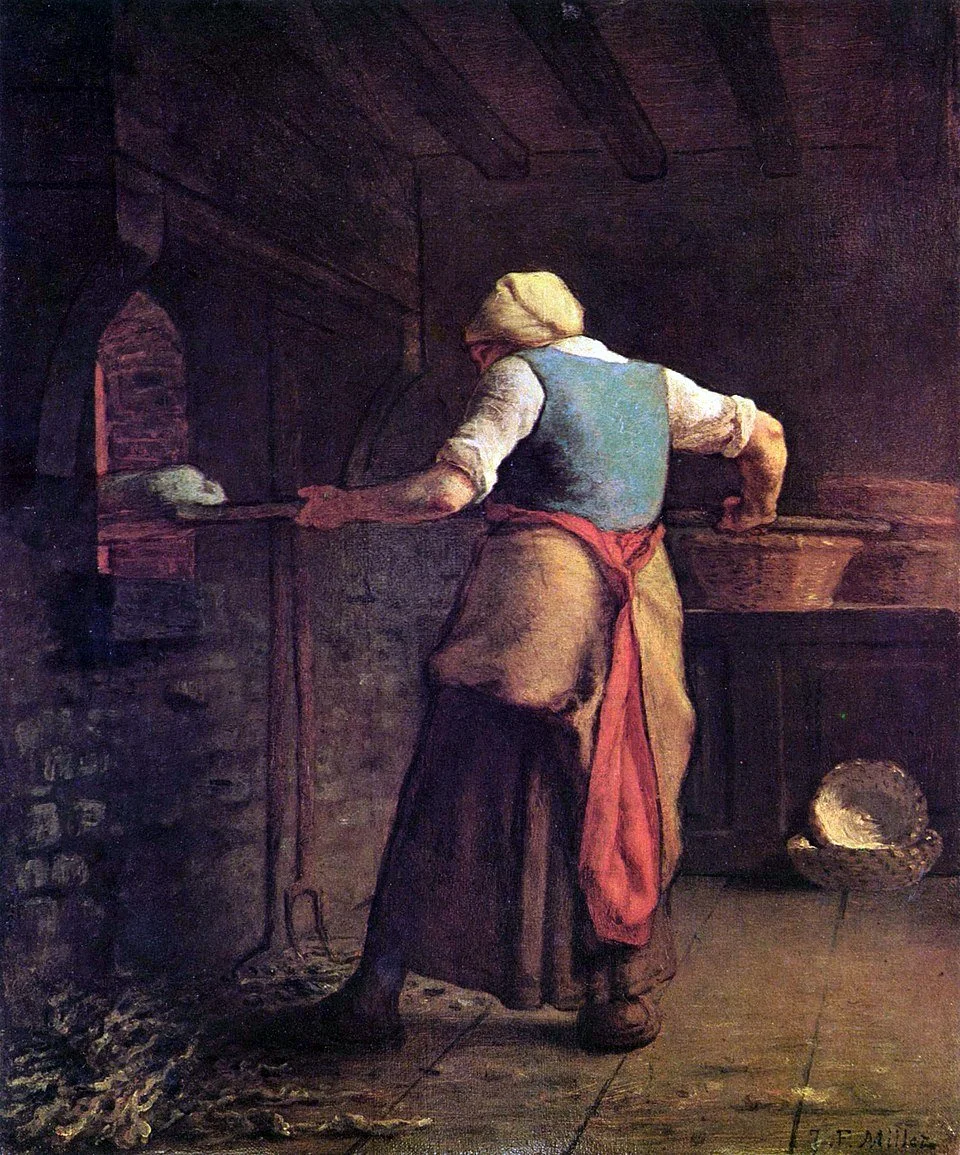
Woman Baking Bread by Jean-Francois Millet (oil on canvas, 1854)
The Spiritual Dimension of Faith and Intellect
Now the pursuit of knowledge is not sufficient, as there is a deeper spiritual calling. Anne Bradstreet, born in 1612, offers this question: How do I know the true God is the one described in scripture?
Bradstreet’s talent, demonstrated in her published poetry collection, The Tenth Muse, was criticized because she was expected to stick to sewing and housekeeping. Notwithstanding, the desire to learn is rooted in a quest for a deeper relationship with God. Faith, as it were, should be scrutinized.
RC Sproul wrote in his article, “Burning Hearts Are Not Nourished by Empty Heads,” that a passionate faith requires understanding and intellectual engagement. Christ calls us to a faith that harmonizes heart, head, and hands.
Anne Dutton’s theological works proved a clear understanding of Scripture and refuted perceived error, arguing that learning helps women stop their ears against seducers.
Other examples of those who prioritized growth and stewarded their talents are found in the Bible in the lives of Mary and Martha. Of the two sisters, which one pursued that good part which shall not be taken away from her (Luke 10, verses 38 through 42)? Mary’s the one. Her choice to sit at Jesus’ feet illustrates the primacy of spiritual and intellectual nourishment, as Christ invited women to be His disciples.
It is a tragedy to bury one’s talents. The season of singleness is a divinely appointed time for discovery and development. Paul charged Timothy to set “an example of the believers, in word, in conversation, in charity, in spirit, in faith, in purity” (1 Timothy 4, verse 12). This is a direct command to a young, single individual to use his or her time for spiritual growth and ministry.
A Call to a Higher Standard
An active, intentional life leads to greater personal and spiritual development for young Christian women. It is better to be the good woman worth finding, living visibly through character, joy, and faithfulness, rather than stressing over how or when you will be found. The need for clarity and hope keeps a woman expectant. Clarity grounds her in truth, knowing that her worth is not dependent on marriage; she is whole today, with or without a spouse.
A smart man will want a smart woman. A wise man will want a wise woman. A prepared man will want a similarly prepared wife. Luke 2 verse 52 states: “And Jesus increased in wisdom and stature, and in favour with God and man.”
A woman, then, as she pursues Christ-likeness is responsible in her singleness to increase in wisdom and stature, and in favor with God and man.
It is with great conviction that we teach our young sisters in the Lord to reject mediocrity and instead do greater things. Embracing a rich legacy of intellect and purpose, using the season of singleness to develop talents, stretch the mind, and prepare to be a blessing is an act of obedience to Christ. This not only is a blessing to the future family God may give her, but also to the Kingdom of God.
You don’t need to be fearless to reach your goals, you just need to be willing. Willing to try, willing to learn, and willing to believe that you’re capable of more than you know. The road may not always be smooth, but growth rarely is. What matters most is that you keep going, keep learning, and keep believing in the version of yourself you’re becoming. ❧
To learn more about how fathers impacted the education of their daughters and the significance of how women’s minds shaped history, read Simonetta Carr’s Questions Women Asked: Historical Issues, Timeless Answers.
❧ AT THE TABLE SOCRATICS ❧
-
Defining the Core Idea: What does the word "industrious" mean in the context of this essay, and what are two practical examples the author gives of an industrious woman?
Identifying the Contrast: According to the essay, what is the main difference between how the modern world views work in the home versus how the Christian tradition views it?
-
Analyzing the Argument: How does the author contrast the idea of being a passive "consumer" with being an active "producer" in the household? Why does the essay argue that producing is more virtuous?
Finding the Cause: The title uses the word "Renewing," which means bringing something back to life. Based on the author’s arguments, what specific historical or cultural shifts caused this vision of womanhood to be lost or forgotten in the first place?
-
Evaluating the Thesis: Do you agree with the author's premise that reclaiming industriousness in the home is a necessary act of spiritual and cultural renewal? Defend your position using both the essay and a supporting text (such as Proverbs 31 or another classical work).
Synthesizing & Applying: If a modern family wanted to fully embrace the principles of "industrious Christian womanhood" described in this essay today, what modern cultural obstacles (e.g., technology, economics, social expectations) would they face, and how could they practically overcome them?